


Location
The district is bounded as follows:
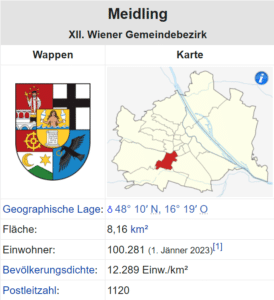
The 12th district is located in the southwest of Vienna, about 5 to 10 km from the inner city. Topographically, it extends from the Wiental valley south of the Wien river into the plain between the Wienerberg in the 10th district and the Grüner Berg, the hill of Schönbrunn Palace, in the 13th district.
Land use and water bodies
The most important body of water in Vienna's 12th district is the Wien River, which runs from the districts of Hietzing and Penzing along the district border with Rudolfsheim-Fünfhaus.
Approximately one percent of the district area of Meidling is taken up by playgrounds. This is the highest figure of all Viennese districts. More than 13% of the district area is green space.[3]
Districts
The district, after which the "Meidlinger L" of the southern Viennese dialect is named, essentially consists of:
In between are the foothills of the Wienerberg with its geologically young beach terraces and brick pits.
In addition to the cadastral municipalities of Altmannsdorf, Gaudenzdorf, Hetzendorf and Meidling (Obermeidling and Untermeidling), small parts of the cadastral municipalities of Atzgersdorf, Inzersdorf and Inzersdorf-Stadt are also located in the Meidling district. Neumargareten, which was annexed in 1907, has also belonged to the cadastral municipality of Meidling since then.
The district area is also subdivided into the official statistics census districts, in which the census districts of the municipal district are summarized. The eleven census districts in Meidling are Gaudenzdorf, Fuchsenfeld, Meidlinger Friedhof, Wilhelmsdorf, Meidlinger Hauptstraße, Tivoligasse, Gatterhölzl, Oswaldgasse, Am Schöpfwerk, Altmannsdorf and Hetzendorf. Despite some of the names being the same, the boundaries of the census districts do not correspond to those of the cadastral municipalities.
History
The village of Meidling has been known as Murlingen since 1104. Originally, most of the land belonged to Klosterneuburg Abbey. In the Middle Ages, Meidling was mainly used for farming and viticulture. In 1755, a sulphurous spring was discovered, which made the area around the Theresienbad a popular destination for the Viennese. At the end of the 18th century, more and more industry settled here, which completely changed the character of the town. In 1806, this led to the division of the now quite large community into Obermeidling and Untermeidling. In Untermeidling, a separate settlement developed on the site of an old brickworks, which was separated in 1846 under the name Wilhelmsdorf. In 1819, the suburb of Gaudenzdorf developed along the Linienwall, which was replaced around 1900 by the Gürtel as the main road linking several districts, where numerous dyers, tanners and launderers settled due to its location on the Vienna.
The village of Altmannsdorf was first mentioned in a document in 1314 and had a rural character for a long time. It was first named Hetzendorf in 1190, after Henricus von Hetzendorf received it as a feudal fief. It later came into the possession of Klosterneuburg Abbey and the Teutonic Knights. In the 18th century, the village developed into a villa settlement.
On January 1, 1892, all these municipalities were united to form the 12th district of Meidling, which was a typical working-class district. The Wien River was regulated between 1895 and 1900 (see also: Rechte Wienzeile) and the Linienwall near the Gürtel was demolished in 1894. In 1907, Neumargareten, the part of the 5th district west of the Gürtel, was transferred to the 12th district.
In 1898, the Meidling Hauptstraße station connected the district to the Vienna Steam City Railway network, which in turn was replaced by the Vienna Electric City Railway in 1925.
From 1909 to 1920, Hermine Santrouschitz lived as a child in poor circumstances in Meidling. She later became known as Miep Gies and was the main helper in Holland of Anne Frank, who was threatened by National Socialism and whose diary she rescued.
Since 1980, the subway line U4 has been running to Meidling instead of the light rail. The new subway stations Längenfeldgasse (lines U4 and U6), Niederhofstraße and Meidling station (until 2013 Philadelphiabrücke), both U6, have been in operation since 1989, and the stations Tscherttegasse and Am Schöpfwerk were added in 1995 when streetcar line 64 to Siebenhirten (23rd district) was converted to U6 operation.
In terms of road traffic, the so-called Altmannsdorf branch of the south-east bypass (A23) was built by 1978, providing access from Altmannsdorfer Straße to the A2 south highway and the bypass to the north-east. Meidlinger Hauptstraße was opened as a pedestrian zone in 1994.
The ÖBB tracks to the west and south of Vienna Meidling station were extended and converted for high-speed traffic, as the tracks of the Lainzer Tunnel have been running into this station and the connected Donauländebahn since 2012.
In the 1920s, many municipal housing estates called "Gemeindebauten" were built in the Gürtel area. The areas of Hetzendorf and Altmannsdorf remained rural, but terraced housing estates were built during the Red Vienna period and extensive housing estates after the Second World War.
In the 1990s, there were several small changes to the district boundaries. The border to the Favoriten district was drawn in 1995 in the area of Wienerbergstraße[4] and in 1999 at the Matzleinsdorf freight station[5] was moved. The border to the district of Liesing was changed as follows: 1995 in the area of Am Schöpfwerk[6] and in the area of Wilhelm-Erben-Gasse[7] and in 1997 on Rosenhügel in the area of Emil-Behring-Weg and Wundtgasse.[8] In addition to traffic areas, these boundary changes mainly affected individual residential buildings, allotments and a large apprentices' home in Kundratstraße, which fell to Favoriten.
1120 Vienna
